
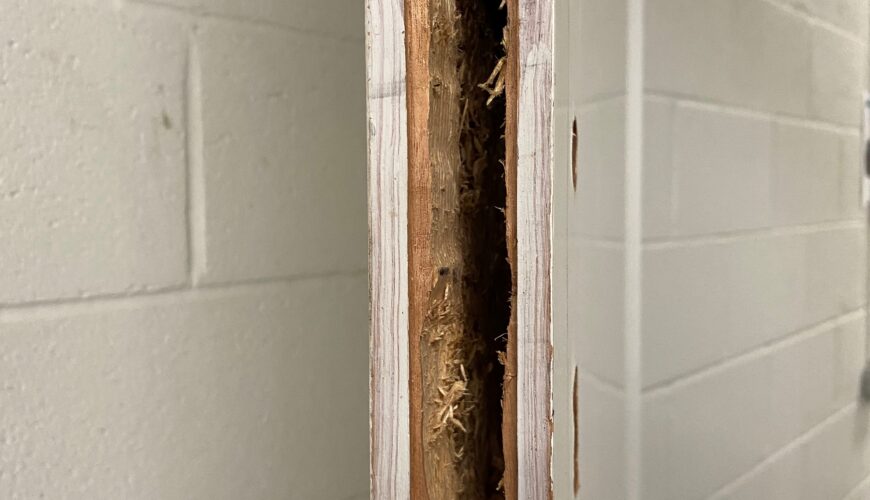
When we say more Fire Door Training is required in the building industry what do we mean? Many would assume that we are referring to those that are actually fitting the fire doors, but is this always correct? As with all fire protection devices, anyone fitting fire doors must be competent. Surely though those responsible for the procurement process should be aware of how they can affect the suitability of the finished product.
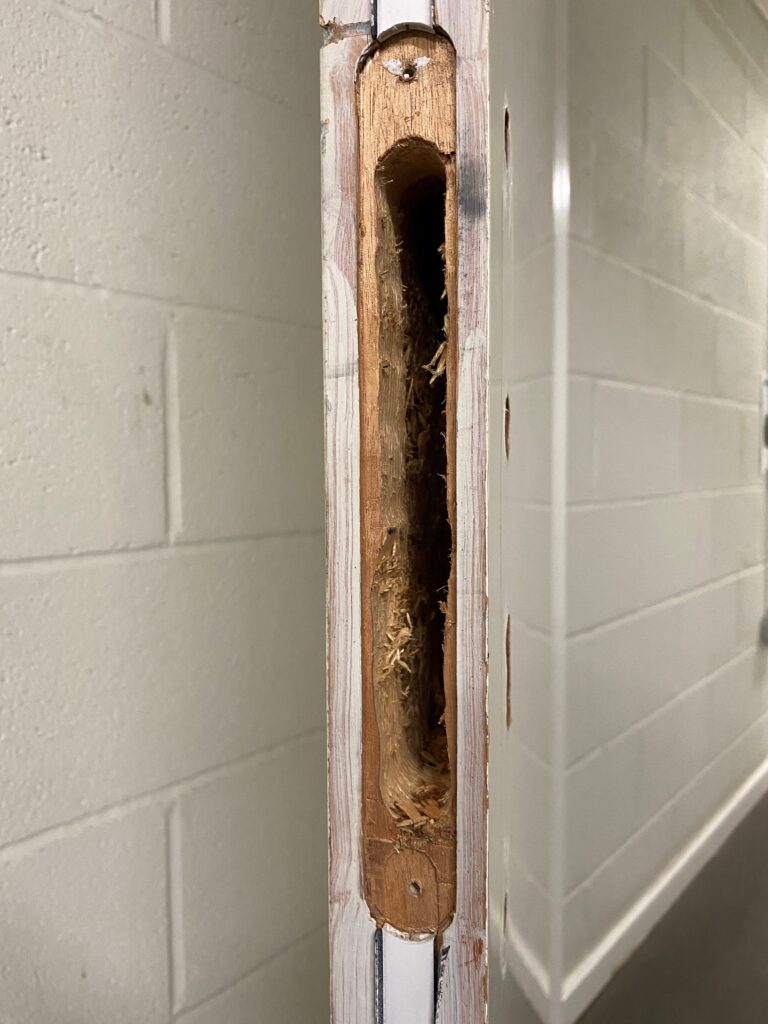
From a joinery viewpoint the lock prep’ shown in the picture could be better. The mortice is uneven and there is a significant amount of splintering of the timber.
If this were a standard door, then the workmanship is not ideal, but as it is covered up on the finished door, it would have little or no impact on the ability of the door to perform the function for which it is designed – or be ‘fit for purpose’.
However this is a fire door – an FD30S fire door, which is expected to hold back intense heat and smoke for a minimum of 30 minutes – during which time the door is likely to be subjected to temperatures up to around 850⁰ Centigrade*, and ‘defects’ such as this can make the difference between a door lasting 10 minutes or 40 minutes!
The mortice on this door is uneven and much wider than it needs to be to accommodate the lock case. This means there is less timber to burn away and of course the splintering helps flame to spread much more quickly (those of us old enough to have had a ‘real’ fire will understand that thin pieces of timber ignite much easier than logs). Also the mortice is not protected with any intumescent material around the lock case which would be a significant improvement. Hardly visible in this picture the holes through the face of the door are also much larger than required.
So who is to ‘blame’ for this example?
Who is it that needs more Fire Door Training?
Obviously the workmanship on this door could be better, that much is clear. Perhaps though we should consider the bigger picture before demonising the fitter, who may have been working under less than perfect conditions with pressure from management.
Should we question why the doors were not delivered to site with the lock prep already carried out?
Could the person ordering the doors perhaps consider an alternative approach, one that could deliver a ‘fit-for-purpose’ product repeatedly with none of the ‘common faults’ found with doors fitted in a more traditional manner.

Many fire door and doorset manufacturers have extremely accurate CNC controlled routing machines. Theses machines can mortice out for locks in doors very accurately and of course they can do it every time.

Allowances can be made for intumescent gaskets to be fitted.
Holes through the face of the door can be cut as accurately as the lock mortice.

The result?
A fire door with as much of the material as possible left intact.
A lock prep that is just big enough for the lock, but no more.
The correct allowance for any intumescent gaskets that may be required.
Perhaps more importantly though a fire door that is more likely to perform to its design requirement.
Could this then be an example that those purchasing fire doors and doorsets would benefit from a degree of Fire Door Training?
Would training help them understand the effect of some of their choices to the installation of the product on site and the potential difference to the finished product?
Just to be clear, we are not for one second suggesting that poor standards of installation should be accepted – we are just looking at the big picture and suggesting other options.
*BS476 temperature curve hits approximately 850⁰ at 30 minutes duration.