
As a building owner, whether it be a new-build development, a refurbishment or upgrade of an older building, it goes without saying that you should be provided with products that are fit – for – purpose, or ‘fire safe’ to protect your building and the lives of those that attend, work or live in it.
But how often does that happen, especially with fire doors?
With the current and ongoing focus on fire safety and indeed the recent introduction of the Fire Safety Act one could be forgiven for assuming that fire doors, especially new installations would be fully compliant and therefore ‘guarantee’ the required level of protection against fire – even more so with the increase of Third Party Certified (TPC) Installer Schemes.
Sadly, our experiences say otherwise.

The above is the ‘Dashboard’ summary of a recent report issued following an inspection of the fire doorsets fitted in a new building shortly before it was due to be handed over to the client. The number of non-compliances are nothing short of astounding, obviously not in a good way!
To make matters worse, the installation was carried out by a TPC Installer.
As I’m sure anyone reading this can imagine the substance of our report and the implications on the scheduled completion of the building which came as a complete shock to the Client and indeed the Main Contractor. Thankfully though the client was able to pass our detailed report to the Main Contractor so that rectification works could be undertaken to rectify the non-compliances before Practical Completion when the building site (the responsibility of the builder) became a ‘finished’ building and the responsibility for fire safety compliance became the responsibility of the client.
However this is not always the case!
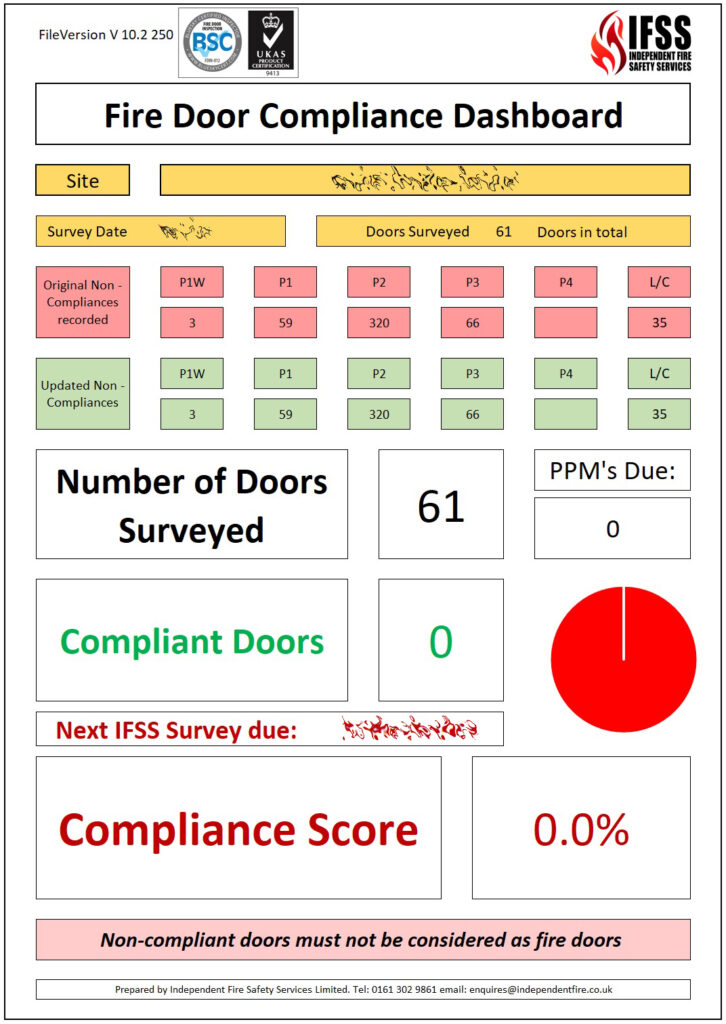
This example is from a building already handed over and in full use. We only had 2 days to carry out an indicative survey, and had to work around those ‘using’ the property, so didn’t manage to get round the entire project but once again the figures above speak volumes.
Who’s to blame? Main Contractor or Installer?
That’s not always an easy question to answer fairly in our opinion.
Of course in both of these instances the installation company could easily be blamed as ultimately it is they who are initially ‘signing off’ each door(set) as complete however it’s not always as straightforward as that. We know that pressure was put on the installation team by the Main Contractor to complete one of the projects despite them having misgivings as to the suitability of the doorsets as delivered (obviously we can’t go into details), and perhaps unsurprisingly they buckled.
Are doors really fitted that badly?
Sometimes yes!
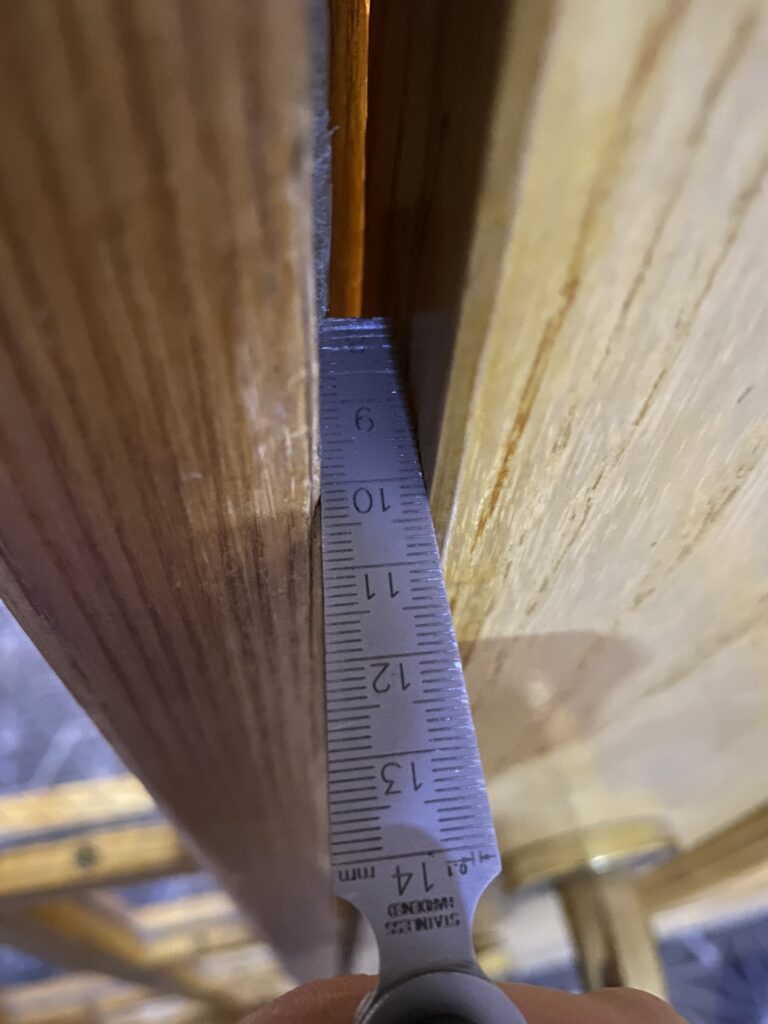
The picture below showed one of the cross-corridor fire doors in a hotel the author stayed in only this week. This door would offer no protection whatsoever against cold smoke and looking at the size of the gap between the door and the frame, 10mm, we would suggest it would offer very little protection against fire either. Every door on the floor were in a similar condition, including the bedroom door.
Our concerns were passed onto hotel management who’s response was “well the fire service never mentioned it the last time they were here…”.
We’re not sure if these doors are the original or were fitted as part of a refurb but either way they will definitely not do their job!
Should the Clerk of Works not have spotted the issues?
Arguably yes, but in reality a Clerk of Works is not always employed on building sites any longer, which may be due to a number of reasons not least of which could be the cost, but even when there is a CoW on site it is perhaps unrealistic to expect them to have the required level of knowledge on EVERY component that goes into a building and a specialist should be called in.
How can you avoid this happening to you?
Not surprisingly we would recommend you engage the services of a specialist company such as ours to act as ‘Clerk of Works’ solely concentrating on the fire doors.
We would generally suggest a number of visits to site:
Pre installation – to meet with the installation team and discuss the common faults (the ones that ALWAYS occur).
Commencement – literally the first day or so of installation (particularly if the doorsets are being fitted in one go as opposed to frames installed first and then doors to follow). On this visit any snags can be identified and rectified and a ‘line in the sand’ established as to the standards required. Depending on the scale of the project this could be repeated during the various phases.
Completion – once all the doors are installed a full survey is carried out and a (hopefully short) snagging list is prepared and passed back to the Main Contractor / Installer.
Sign off – final visit to check off any snags raised and confirm all doors to be compliant. Obviously in a new-build scenario and depending on the construction type a certain degree of movement could be expected during the first few months of occupation of the building so a further inspection may be advisable.
Is it worth the cost?
That’s not for us to say but ultimately should they ever need to perform their critical role, protecting lives and the building in a fire event, it could be money very well spent.